
Huntsville Tree Removal Pros has worked as an arborist and tree risk assessment provider in Huntsville, AL for more than twenty years, serving surrounding cities including Redstone Arsenal, Madison, Triana, Harvest and Meridianville. That is condition assessment, decay diagnosis, dead and hazardous tree removal, and the written finding somebody needs when a letter, a claim or a height question is involved. It is deliberately separated from the removal work, so an inspection can end in a recommendation to keep a tree.
Twenty years in this valley is what makes the assessment worth reading. The limestone floor and the escarpment slopes of Monte Sano and Green Mountain grow different trees on different soils, and a defect that means very little on one is the failure mechanism on the other. A crew that has taken down the same four species across this metro for two decades knows which unions part first and which hollow stems have been standing since before the subdivision.
The assessment is priced as its own deliverable rather than bundled into a sales visit. That matters because the two documents look identical from the outside: one is a professional finding you can file with an insurer, hand to a neighbor or take to a permit office, and the other is a quote with an alarming paragraph in front of it. You get the finding, the evidence behind it, and the date it was observed.
What a Tree Risk Assessment Actually Measures
Likelihood, Target and Consequence
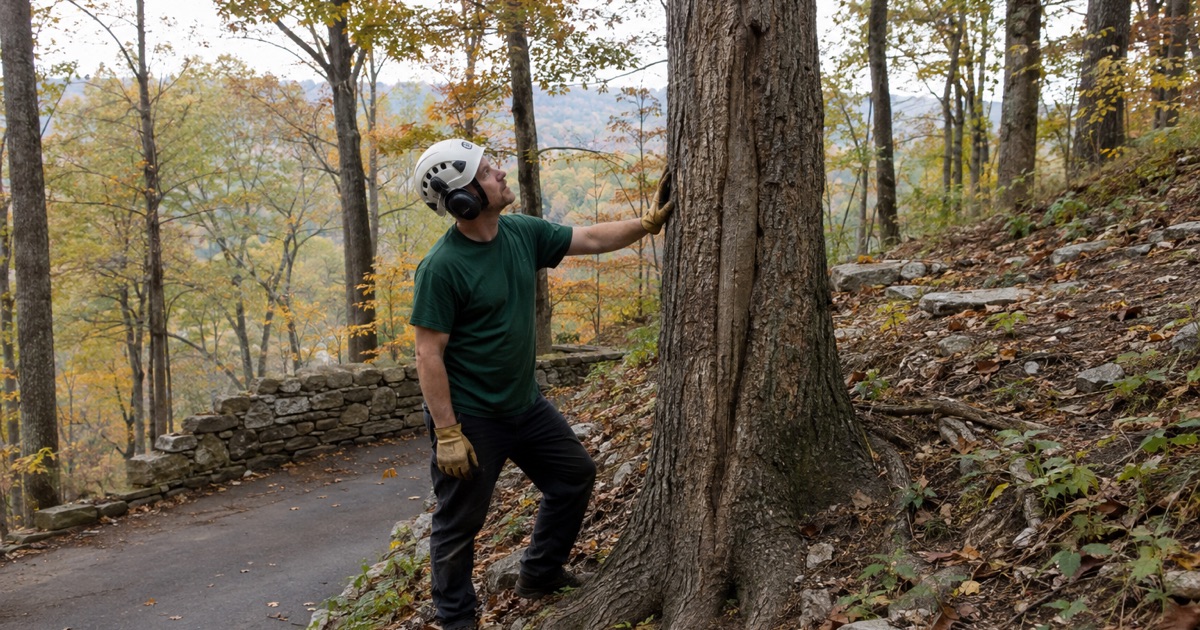
Risk in this trade is not a property of the tree alone. The industry framework asks how likely a part is to fail, how likely it is to strike something if it does, and how severe that strike would be. A hollow sweetgum standing over a hay field and a sound water oak with a cracked union over a driveway produce opposite verdicts, and any assessment that skips the target and the consequence is only describing wood.
Diameter at Breast Height and the Critical Root Zone
Two measurements set the scale of everything else. Diameter at breast height drives the size of the parts that can come down and the equipment needed to control them; the critical root zone, projected outward from the trunk, is where anything that damages the tree has already happened. Both go on the report as numbers, because a report that says the tree is large is not something anybody can act on two years later.
The Defects That Actually Predict Failure
Co-dominant stems with included bark between them, a decay column at an old wound, a root flare buried under fill, girdling roots strangling the base, and bracket fungus or a root-flare conk are the findings that change a verdict. Tension perpendicular to the grain is the wood property that pulls an included-bark union apart, and it is the weakest number in the tables for every species in this valley.
Diagnosis: How the Inside of a Tree Gets Read
Sounding, Resistance Drilling and What Each One Answers
A sounding mallet is the first tool and often the last: a hollow answers at a different pitch than sound wood, and a competent pass around the base narrows the question fast. Where it stays open, resistance drilling produces a trace showing where sound wood ends and decay begins along one line. Neither is used routinely, because both cost money and most trees do not need them.
Why the One-Third Hollow Rule Does Not Survive Its Own Source
The rule of thumb that a tree with a third of its trunk hollow must come down is repeated everywhere and does not hold. The literature it comes from sets a shell-thickness ratio, field-stated as roughly an inch of sound wood per six inches of diameter, and the same body of work records failures well above that ratio and thousands of standing, stable park trees well below it, with nothing supporting the rule on trunks past about thirty-six inches.
Root Collar Excavation Without a Shovel
Most of what kills a mature tree in a developed yard happens below grade and out of sight: fill piled against the trunk, a root flare buried, roots circling from an old container, or compaction from a build. An air-excavation device blows soil away from the root collar without severing anything, so the flare can be inspected and the decision made on what is genuinely there rather than on a guess about what is under the mulch.
Dead and Hazardous Tree Removal
Dead Ash on a Short Clock
Emerald ash borer was recorded as a first detection in Madison County on June 6, 2025 by the Alabama Forestry Commission. Ash killed by it loses toughness while it is still standing, which turns a routine climbing removal into a crane or lift job within a season or two. An ash flagged in an assessment gets a recommended window rather than an open-ended note, because the price of waiting is a different method.
Pines, Pitch Tubes and the Drought Trap
Southern pine beetle activity shows as pitch tubes and boring dust on the trunk, and Ips engraver galleries appear under the bark of stressed and broken wood. The trap is that a drought-stressed pine may not produce pitch at all, so the tubes stop appearing while the beetles keep working. Stand density is the manageable lever, and thinning is a real alternative to losing a block of pines one at a time.
Taking Down a Tree That Cannot Be Climbed
A structurally compromised stem is not a climbing removal, because the anchor points are the part in question. Those come down by sectional dismantling from a tracked spider lift or a crane, or by directional felling where there is genuinely room, with the notch and back cut set by the industry safety standard rather than by eye. Working distances for everyone not on the saw are set the same way.
Written Findings, Letters and Height Questions
Documentation for a Boundary Letter
Where a tree is the subject of a dispute with a neighbor, the useful artifact is a dated written finding rather than a conversation. Alabama treats a trunk standing on the boundary as held in common by both owners, so a report that establishes condition and location is what lets two owners decide together instead of one of them acting alone and creating a second problem.
Insurance Claims and What an Adjuster Reads
An adjuster works from evidence with a date on it. A pre-loss condition report, or a post-event finding describing where the trunk lay before anything was cut, is worth more than any amount of description afterward. Alabama’s insurance department publishes what is generally payable, and the estimate is written so the covered removal and the uncovered portions stay separable rather than blended into a single figure.
Height Near the Airport and the Arsenal Overlay
Huntsville’s zoning carries an airport obstruction article, the City of Madison has its own tree-height provision with an explicit fifty-foot safe harbor, and the Redstone military compatibility overlay reaches vertical obstruction across several jurisdictions in this ring. None of that is settled by opinion. What the assessment supplies is a measured current height and a located tree, which is the input the height authority actually needs.
Our Step-by-Step Tree Risk Assessment Process
Step 1: Scope the Question Before the Visit
An assessment is cheaper and better when the question is specific. A neighbor letter, a pre-purchase inspection, a claim and a construction plan need different documents, and knowing which one is in play decides whether the visit covers one tree or a whole property line.
Step 2: Walk the Site and the Targets
The walk covers the tree and everything it could reach: structures, drives, play areas, parked vehicles and the frequency people are actually under it. Access gets measured on the same pass, since a tree that may need to come down later prices differently depending on gate width and where a machine can sit.
Step 3: Escalate Only Where the Visual Leaves a Gap
Sounding, resistance drilling or root collar excavation get used where the visual pass leaves a genuine question, and are named on the estimate with their own price. Nothing invasive happens without that being agreed in advance, and a tree that reads clearly does not get billed for instruments it never needed.
Step 4: Deliver the Finding, Then Price the Work
The report states the observation, the evidence and the date, and recommends a course of action, which is sometimes cabling and sometimes nothing at all. If removal is the recommendation, the quote is written from measurements already taken, with the takedown, the stump and the debris as three separate lines.
- 20+ Years in the Valley
- Free Written Estimates
- Same-Day Storm Calls