
Huntsville Tree Removal Pros answers the tree removal permit question in Huntsville, AL more often than almost any other, and the plain answer surprises people: for a tree on your own private lot inside the city, there is no city permit to get. Twenty years of doing this work here is largely twenty years of explaining where that answer stops being true, because it stops in several places at once.
The rules that actually bind a homeowner in this ring are layered and they do not all come from the same office. The city’s vegetation ordinance reaches public land and the right of way. A subdivision covenant reaches where the city does not. Out in unincorporated Madison County no municipal tree ordinance reaches the yard at all, and aviation height overlays reach parts of this ring regardless of any of it.
This page sets out what we check before quoting a removal, and what Alabama law recognizes about a neighbor’s tree. None of it is legal advice, and we do not give any. Where a dispute is genuinely live, what we can supply is a dated written finding describing the tree’s condition, which is the document those conversations tend to turn on.
Where a Permit Is and Is Not Required
Your Own Private Lot: No City Permit
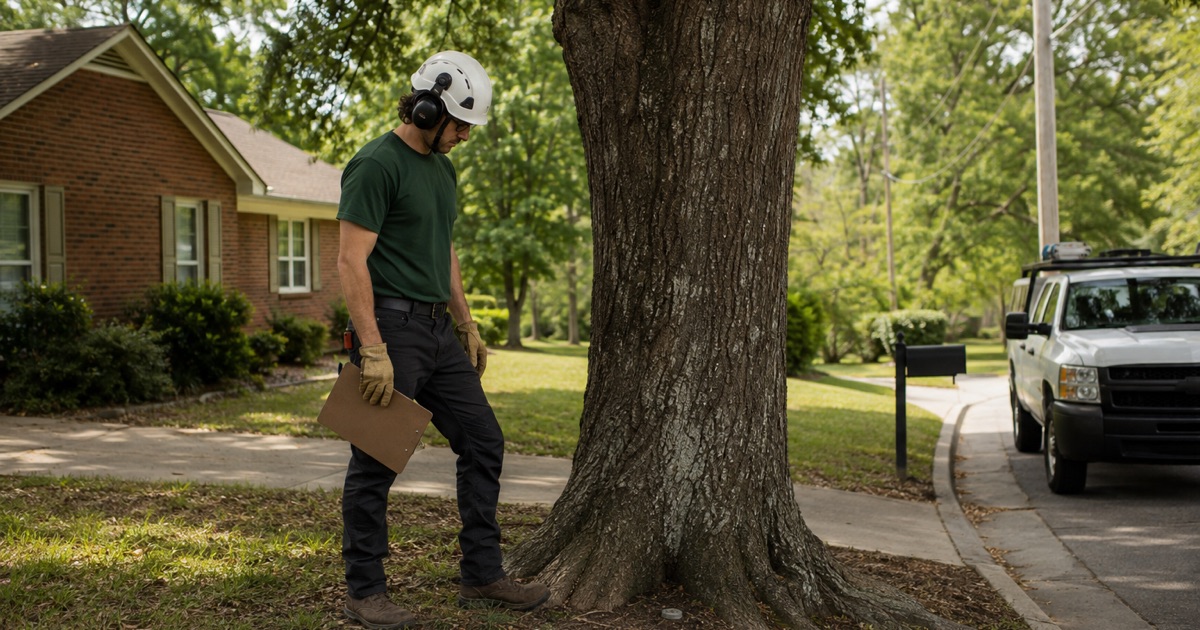
Inside the Huntsville city limits, removing a tree from your own private property does not require a city tree permit. That is the opposite of what a homeowner usually concludes after reading a permit page written for a different state, and it is why some contractors are able to sell a permit-handling service that has nothing to handle. What does apply is the covenant question and, on a construction site, land disturbance.
Public Land and the Right of Way
The city’s ordinance does bind on public land and in the right of way, where trees at or above six inches in diameter go through the City Arborist rather than through whoever is holding the saw. That is a genuine review with a genuine office behind it. We establish which side of the line a tree stands on during the estimate, because the answer changes who is legally able to authorize the job.
The Strip Between the Sidewalk and the Street
The planting strip between a sidewalk and the curb is right of way through most of this city. The homeowner mows it, waters it and reasonably believes the tree in it is theirs, and it is not theirs to cut. Contractors quote those trees regularly without checking. It is a City Arborist matter and we route it there rather than pricing it.
Beyond the City: Covenants, County and Districts
Subdivision Covenants and Architectural Review
A covenant binds where the city does not, and in this metro that is where most of the real restrictions live. Plenty of Madison County subdivisions built since 1990 run an architectural review committee with its own tree language and its own approval process, entirely unconnected to the City Arborist. We ask which subdivision an address sits in before writing the estimate, because that question is skipped far more often than the permit one.
Unincorporated Madison County
Outside any city limit there is no municipal tree ordinance reaching a private yard. The county regulates land disturbance, grading and building rather than the removal of an individual tree, which means a large share of the addresses we work around New Market, Hazel Green and Moores Mill have no tree approval step at all. That leaves the covenant question, and sometimes an easement, as the only checks worth making.
Historic Districts and the Route to the Tree
Huntsville has four locally designated historic districts. The Certificate of Appropriateness process that governs work in them carries an explicit landscaping exemption, so an ordinary tree removal does not trigger a review. The access route can: removing a terrace wall, a fence, a gate or a section of historic drive so a machine can reach the tree is a change to the property that the review does cover, and it needs sorting out first.
Neighbor Trees and Boundary Trees in Alabama
Branches and Roots That Cross the Line
Alabama recognizes a landowner’s right to cut vegetative protrusions, branches or roots, extending onto their own property. The right runs to the property line and no further, and it does not authorize entering the neighbor’s land or taking down their tree. In practice the sensible route is a conversation first, because pruning hard back to a line can leave a tree lopsided in a way that creates a new argument.
A Trunk Standing on the Boundary
Where the trunk itself straddles the line, Alabama treats the tree as held in common by both owners and one owner may not cut it. The Alabama Court of Civil Appeals settled that in Young v. Ledford in 2009. A widely circulated attribution of the same rule to a different, unrelated Alabama case is simply wrong and turns up on tree company websites regularly, which is one reason we will not book a boundary-trunk removal on a single owner’s signature.
Putting a Hazard in Writing First
Where a neighbor’s tree genuinely threatens something, the useful artifact is a dated written condition and risk assessment, not a phone call. It records the defect, what it threatens, how severe a failure would be, and when it was observed. That is what an insurer or an attorney can work from, and it is priced here as its own deliverable rather than folded into a quote for taking the tree down.
Height Overlays, Licensing and Insurance
Airport Obstruction and the Redstone Overlay
Parts of this ring sit under aviation height regulation that has nothing to do with tree permits. Huntsville zoning carries an airport obstruction article, the City of Madison has its own provision written in terms of no tree being allowed to grow above an established height, with a fifty-foot safe harbor and a requirement that owners permit hazard markers. The Redstone military compatibility overlay reaches vertical obstruction across several jurisdictions here.
What Alabama Actually Calls Tree Surgery
Alabama’s administrative rule defines tree surgery narrowly: cavity filling, repair, bracing, cabling and wound treatment. Pruning is expressly excluded from the definition, and removal is not named in it at all. So a homeowner asking whether a tree company is state licensed for a removal is asking about a category the state has not created, which is worth knowing before treating a certificate as proof of anything.
The Insurance Minimum That Does Not Exist
The same body of rules sets a minimum insurance requirement only for the three structural pest control categories, so the tree surgery category carries no state insurance minimum whatsoever. That places the burden on the homeowner: ask for a certificate of insurance from the insurer, check general liability and workers’ compensation, and check the dates. On any job over a roof or near a conductor, that document matters more than any badge on a truck door.
- 20+ Years in the Valley
- Free Written Estimates
- Same-Day Storm Calls