
Huntsville Tree Removal Pros handles tree disease treatment and plant health care across Huntsville, AL as a diagnostic service first. Twenty years of removals in this valley have made one pattern very clear: a large share of the trees we are called to take down were killed by something done to their roots years earlier, not by an infection that arrived last month.
So the order of work on this page is deliberate. Identify what is actually wrong, separate the genuine pathogens from the cultural damage that mimics them, and only then talk about treatment. A treatment sold before a diagnosis is a subscription, and this trade has plenty of those. The diagnosis is priced as its own deliverable and can end in a recommendation to change nothing.
Where the answer is a chemical treatment, we say so and say who does it. Pesticide application in Alabama is licensed work with its own requirements, and coordinating it honestly is worth more to a homeowner than a vague promise about feeding a tree.
Insects That Kill Trees in North Alabama
Emerald Ash Borer, Confirmed in Madison County
The Alabama Forestry Commission recorded a first detection of emerald ash borer in Madison County on June 6, 2025. That date matters because a competing local site dates it several years earlier, and the difference changes what a homeowner should do now. Ash killed by this insect loses toughness while still standing, so a declining ash goes from a climbing removal to a crane job faster than most species.
Southern Pine Beetle and the Stand-Density Lever
Southern pine beetle activity shows as pitch tubes and boring dust on the trunk, and the state’s own hazard rating turns on stand density more than on anything a homeowner can spray. The trap is that a drought-stressed pine may produce no pitch at all, so the tubes stop appearing while the beetles keep working. Thinning a crowded stand is the practical intervention, and it is a tree service job rather than a chemical one.
Ips Engraver Beetles in Stressed and Broken Pine
Ips engravers colonize pines that are already stressed, storm-damaged or freshly cut, and their galleries under the bark are distinctive once you know what you are looking at. They are a strong argument for not leaving fresh pine wood lying around a property with living pines on it, which is one reason the debris line on a storm job is not purely cosmetic.
Fungal Problems You Can Actually See
Hypoxylon Canker on Stressed Hardwoods
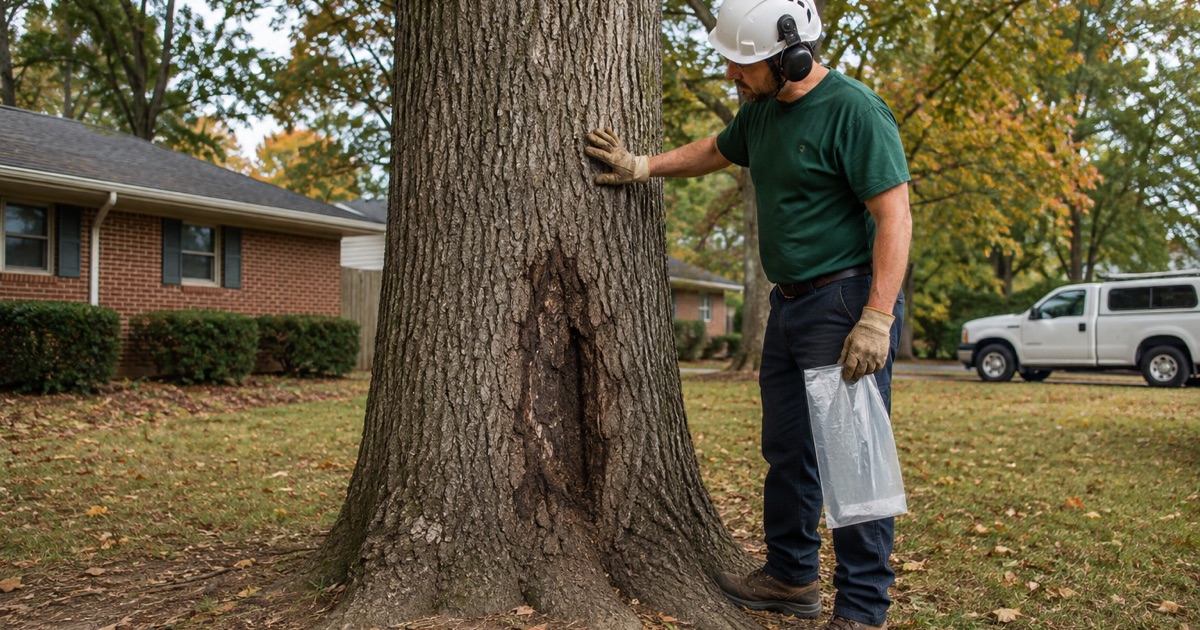
Hypoxylon is an opportunist that lives quietly in healthy hardwoods and turns lethal when the wood dries past a threshold, which is why it follows drought and root damage rather than causing them. The visible sign is bark sloughing off in sheets to reveal a hard, dark crust underneath. By that stage the affected wood is already dead, and the tree is a structural question rather than a treatment question.
Seiridium Canker on Leyland Cypress
Leyland cypress planted as a screen at six to eight feet apart, against Alabama’s own recommended fifteen to twenty feet on centers for a tree that matures at seventy feet or more, is the setup this canker exploits. Individual branches or whole stems flag brown with resin bleeding at the lesion, and it moves down a crowded row. Spacing is the underlying cause and it cannot be fixed after planting.
Bracket Fungus and the Root-Flare Conk
A bracket fungus on the trunk or a conk at the root flare is the fruiting body of a decay organism that has been working inside the wood for a long time, and its position tells you which part is compromised. A conk at the flare is the most serious version, because that is where the whole tree’s load is transferred into the roots. These findings frequently change a risk verdict on their own.
Problems That Look Like Disease and Are Not
Girdling Roots and a Buried Root Flare
A root that circled in a container keeps circling after planting and eventually tightens across the trunk, strangling the tree slowly enough that nobody connects the decline to the planting. A flare buried under fill or mulch does something similar from the other direction, keeping bark wet that was never meant to be. Root collar excavation with an air-excavation device exposes both without cutting anything.
Compaction After Construction
Traffic, spoil and materials stored inside the critical root zone during a build compact the soil and crush the pore space roots need for air and water. The tree usually looks fine for a few years and then declines, long after the contractor has gone. It is the most common cause of unexplained decline in a newer subdivision and it is largely preventable with fencing at the tree protection zone.
Herbicide, Drought and Mower Damage
Broadleaf weed killer drifting or moving through soil, string trimmer damage repeated around a thin-barked trunk, and drought following a wet establishment period all produce symptoms that get blamed on disease. Each has a different signature and a different fix, and none of them responds to a fungicide. Ruling them out is part of what the diagnostic visit is for.
Diagnosis, Soil Work and Honest Limits
Diagnosis Before Treatment, Always
A diagnostic visit starts at the root flare and the soil, moves to the trunk and the unions, and finishes in the canopy, because that is the order in which causes usually run. Where the visual pass leaves a real question, sounding and resistance drilling answer specific questions about internal decay. Nothing invasive happens without being named and priced first.
Radial Trenching, Decompaction and Vertical Mulching
Where compacted soil is the problem, the work is mechanical rather than chemical. Radial trenching with an air-excavation device opens channels out from the trunk without severing roots, and vertical mulching backfills bored holes with coarse material to restore pore space. Both are soil decompaction techniques. They are sometimes described locally as a way of feeding a tree, and that description is simply wrong.
When the Right Answer Is Removal
Some trees are past the point where any money spent on them buys time. A hardwood with a root-flare conk and a target underneath, an ash with most of its crown gone, a pine already colonized through the trunk: recommending treatment on any of those is selling hope. We will say that, quote the removal as three separate lines, and note in writing what the failure mode was so a replacement does not repeat it.
- 20+ Years in the Valley
- Free Written Estimates
- Same-Day Storm Calls