
Huntsville Tree Removal Pros runs crane tree removal across Huntsville, AL for the trees that should not be dismantled any other way: stems standing over a roof, decayed trunks nobody should be tied into, and storm-damaged wood holding load in places a climber cannot control. Twenty years here is what tells us which of those is which.
The honest framing is that a crane is a method, not an upgrade. Its value is that weight leaves the tree rather than travelling down through it, so nothing is dropped onto a structure and nothing depends on a rigging point in wood whose soundness is the question. On a tree in open ground with room to work, a crane adds cost without adding safety, and we quote it that way.
What decides whether this is even possible is setup. Where the machine can stand, what that ground can carry, what is overhead in the swing path, and how far the reach has to extend all get settled during the estimate. A crane price given without that site visit is a guess, and guesses on this job get renegotiated on the day.
When a Crane Is the Right Method
Trees Standing Over a Roof
A large stem leaning over a house is the classic case. Climbing it means rigging every piece down through the crown with a bull rope, a rigging block and a friction device, with the loads passing directly above the thing you are trying to protect. A crane picks each section and swings it clear before it can go anywhere else, and that changes the failure mode from a damaged roof to a longer day.
Stems Nobody Should Be Tied Into
A climbing removal depends on the tree holding a climber and their rigging loads. On a trunk with a decay column, a root-flare conk, storm cracking or an ash killed by the borer, the wood being trusted is the wood in question. Those come off from a crane or a lift, so the person cutting is never supported by the structure being taken apart.
Long Carries and Nowhere for the Wood to Land
Sometimes the tree is straightforward and the ground is not. A back yard with a hundred-foot carry to the truck, a courtyard with no drop zone, or a lot where the only clear space is a neighbor’s turf all make the removal itself the easy part. Lifting the wood out over the house to a truck at the curb can be cheaper than three crew members carrying it for a day.
Setup: The Part That Decides the Price
Where the Machine Stands, and What It Stands On
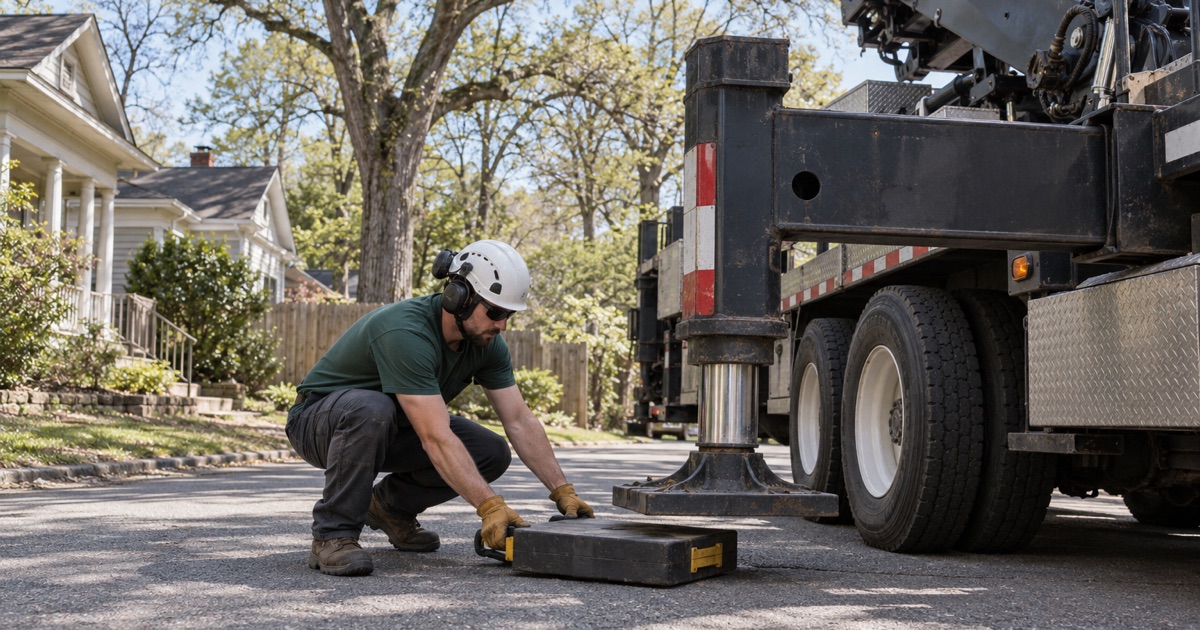
Outriggers concentrate a great deal of load into four small footprints, so the setup gets chosen against what is underneath: septic tanks and fields, shallow utilities, a thin residential drive, a segmental retaining wall, or fill over a former excavation. Pads spread the load, but the right answer is often a different position rather than more pads.
Overhead Conductors in the Swing Path
The swing path is three-dimensional and the wires are the constraint that matters. Primary distribution lines, the service drop to the house and any communications lines all have to be cleared or accounted for, and required clearance from an energized conductor depends on the voltage on it. Where the drop is in the way, in Huntsville that wire is the customer’s responsibility and we arrange the disconnect first.
Streets, Shared Drives and the Neighbors
A crane set up in a residential street is a temporary occupation of it. Traffic control gets arranged, the neighbors get told, and on a shared drive the other users get asked rather than assumed. On the older, narrower streets in parts of this city that planning is most of what makes a crane day run start to finish without stopping.
Picks, Rigging and Load Control
Sizing Every Pick Against the Chart
A crane’s capacity falls off as the load moves out from the machine, so every pick is planned against the load chart at the radius it will actually be taken at. Green wood is heavy and homeowners consistently underestimate it. Sections are cut to a size the chart allows with margin, which is why a crane removal comes off in more, smaller pieces than people expect.
The Climber, the Saddle and the Cut Sequence
The climber sets the sling, makes the cut and stays clear as the section lifts, working from a climbing saddle or from a lift basket depending on the tree. Cut sequence is planned so each piece leaves without loading what remains, and everyone else stays outside the fall and swing zones. On manual felling the industry standard sets those distances explicitly at twice the tree’s height for anyone not involved and one and a half times for those who are.
Speed Lines and Rigging Where the Crane Cannot Reach
Not every part of a job is in the crane’s reach. Brush and small wood frequently come out on a speed line to a landing area, and conventional rigging with a block and a friction device handles the rest. Working load limits govern what goes on any line, and gear is chosen for the load rather than for what happens to be on the truck.
Alternatives and What the Day Buys
Tracked Spider Lifts in a Back Yard
A tracked spider lift folds narrow enough to pass a gate, tracks across turf with far less ground pressure than a wheeled machine, and sets up on outriggers to put a climber at height without them tying into the tree. For fenced back yards in this ring that a bucket truck cannot reach, it is often the only mechanized option, and it is quoted alongside the crane wherever both are genuinely available.
Knuckleboom Grapple Trucks and Cleanup
The removal is only half a crane day; the wood still has to leave. A knuckleboom grapple truck loads large rounds directly from where they land without anyone rolling or carrying them, which is both faster and safer than the alternative. On a large hardwood the loading method can affect the total as much as the takedown method does.
What a Crane Day Costs Against a Climbing Removal
A crane costs more per hour and frequently less per job, because it compresses a multi-day dismantle into a single controlled sequence. The comparison worth making is not crane against climb, but crane against climb plus the additional rigging days plus the exposure of the structure underneath. We put both numbers on the estimate, with the takedown, the stump and the debris still broken out as three separate lines.
- 20+ Years in the Valley
- Free Written Estimates
- Same-Day Storm Calls