
Huntsville Tree Removal Pros answers emergency and storm tree removal calls in Huntsville, AL the same day, and has done for more than twenty years, serving surrounding cities including Redstone Arsenal, Madison, Triana, Harvest and Meridianville. That means a stem through a roof, a trunk across a drive, a limb resting on the wire to the house, and the hanging branch nobody wants to walk under.
Emergency work is where the wrong sequence costs the most, and the sequence almost never starts with a saw. It starts with establishing what is touching what, which utility owns the wire in question, whether the structure is safe to stand in, and whether the position of the trunk still needs photographing before anything moves. Twenty years of these calls in this valley is largely twenty years of getting that order right.
We also state the limits plainly at the time of the call rather than after a truck is in the driveway. There are conditions in which no competent crew will climb or work near energized conductors, and there are trees that belong to the utility until a line crew has cleared them. Saying so on the phone is more useful than arriving and explaining it.
The First Hour, Before Anyone Cuts
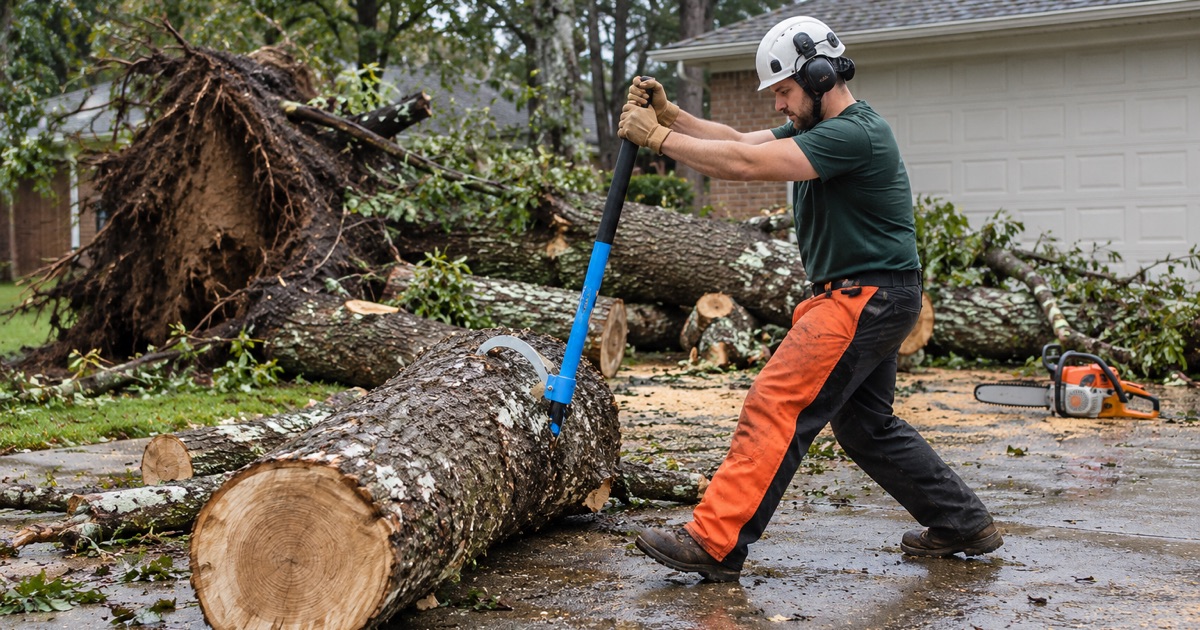
Get People Out From Under the Loaded Side
A tree resting on a house is a live load on framing that was never designed to carry it, and the visible damage is rarely the part that fails next. The first instruction on every one of these calls is to move people and vehicles out from under the loaded portion and stay out of it, including the rooms below, until somebody has assessed what the tree is actually bearing on.
Look for the Service Drop in the Crown
The wire from the pole to the house runs straight through the space a falling tree occupies, and a drop caught in a crown is easy to miss from the ground at night. If any part of the tree is in contact with a conductor, nobody approaches the tree, the structure is treated as potentially energized, and the utility gets called before we do anything else.
Photograph It Where It Lies
Once people are safe, photographs of the tree in position are worth more than any description written afterward. The angle of the trunk, where it entered the structure, what it landed on and how far the root plate lifted are all things an adjuster reads and none of them survive the cleanup. It takes two minutes and it is the cheapest thing on this whole page.
Electrical Hazard and the Limits That Do Not Move
A Tree Across a Distribution Line
A tree lying on a primary distribution conductor is a utility job, full stop. Nobody approaches it, because a downed conductor can energize the tree, the fence it is touching and the ground around it, and a line that looks dead can be re-energized by an automatic reclose. We will make the call, keep people back and stage the removal for after the line crew has cleared and confirmed it.
The Service Drop and Which Utility Will Disconnect It
The pole-to-house wire is where this ring genuinely splits. Huntsville Utilities places responsibility for clearing that drop with the customer. Joe Wheeler EMC takes the opposite position and will arrange to have the line disconnected so the property owner can have the tree cut. Same wire, opposite answer, decided by which utility bills the address, and we confirm it before scheduling.
Why Crews Stop for Wind, Ice and Lightning
The industry safety standard for arboricultural operations addresses electrical hazard and weather together, and no amount of urgency changes it. Climbing gear, a Class E hard hat and experience do not make a conductor in high wind an acceptable place to work. Those limits get stated at the time of the call, so nobody is waiting on a crew that was never going to start in those conditions.
Getting a Loaded Tree Off a Structure
Reading the Load Before Making a Cut
A storm-thrown tree is full of stored energy: bent stems, compressed limbs holding the trunk up, a partially lifted root plate that will move when the weight above it changes. Cutting the wrong member first releases that energy somewhere nobody planned. The work is planned backward from what is holding what, which is why the first thing on site is a walk around rather than a saw.
Crane and Lift Work Over a Roof
Where a stem is bearing on a structure, the right method usually removes weight rather than dropping it. A crane picks sections off and swings them clear so nothing further loads the roof, and a tracked spider lift gets a climber to work positions on a tree that is no longer safe to climb. Rigging with a bull rope and a friction device covers the rest, and sectional dismantling is the default over any target.
Tarping, Shoring and Keeping Water Out
Getting the tree off is half the emergency. The other half is that the building is open to weather, and in this climate a night of rain into an opened roof does damage that outlasts the tree. Covering the opening, and identifying anything that needs temporary shoring before the load comes off, is part of the emergency scope rather than somebody else’s problem the next morning.
Insurance, Debris and the Days After
What an Alabama Homeowners Policy Generally Pays
Alabama’s insurance department publishes the shape of it: removal of a tree that has struck an insured structure is generally payable under dwelling coverage, with a debris-removal allowance stated at $500 per event rather than $500 for each tree that came down. A tree that falls and hits nothing is ordinarily the owner’s own cost. The estimate is written so the covered and uncovered portions can be separated.
A Tree on a Vehicle Is an Auto Claim
A tree that lands on a car is settled under comprehensive coverage on the auto policy rather than under the homeowners policy, which surprises most people the first time it happens to them. Where a single tree hits both a house and a vehicle, that is two claims from one event, and photographing the tree in contact with both before anything is cut is what keeps the two consistent.
Storm Debris and the Curbside Cap
Once the tree is down, the pile becomes a disposal question. Huntsville takes ten cubic yards of yard waste at the curb free and charges past that, caps limb length at five feet, and states in its own policy that it will not collect debris resulting from a contractor’s work. One mature hardwood makes considerably more than ten cubic yards, so the haul is priced in words on the estimate rather than discovered on collection day.
Our Step-by-Step Emergency Response
Step 1: Triage on the Phone
The call establishes what is touching what: structure, vehicle, conductor, road. That determines whether the first call is to us, to the utility or to the city, and it determines whether anybody should still be inside the building. This step costs nothing and routinely saves hours.
Step 2: Make the Site Safe Before Making It Tidy
On arrival, people and vehicles are moved clear, the drop zone and work area are established, and anything hanging is identified and controlled. Nothing is cut until the load path is understood and the electrical situation is settled, including confirmation from the utility where a conductor was involved.
Step 3: Remove Weight in a Controlled Order
Sections come off in the order that keeps the remaining structure stable, using a crane or a lift where a target sits below and rigging where it does not. Anything bearing on the building is relieved rather than dropped, and the opening is covered as soon as the weight is off it.
Step 4: Estimate the Rest in Writing
Once the emergency is over, the remaining work — the balance of the takedown, the stump, and the debris — is quoted as three separate lines, with haul-away stated in words. That is the document an adjuster can read, and it is deliberately not the same piece of paper as the emergency call.
- 20+ Years in the Valley
- Free Written Estimates
- Same-Day Storm Calls