
Huntsville Tree Removal Pros handles tree planting and transplanting across Huntsville, AL, and twenty years of taking trees out is a large part of why. Removal work is a long lesson in which species were planted in the wrong place, at the wrong spacing, or too deep, and this page exists so the replacement does not repeat the tree that just came down.
The species question is settled by the site rather than by a catalog. Mature height against the conductor overhead, mature spread against the drive, the soil the roots will actually occupy, and how the wood behaves in wind are the four inputs. A tree that looks right in a five-gallon container has thirty or forty years to reveal that it never fit the space it was put in.
We also transplant, within honest limits. Moving an established tree succeeds or fails on how much of the root system comes with it, and that is arithmetic rather than optimism. Where the numbers do not work, the recommendation is a new planting, which is cheaper and produces a better tree in less time than nursing a badly moved one.
Choosing a Species That Fits the Site
Mature Size, Overhead Lines and the Ordinance
The most expensive planting mistake in this city is a large-maturing shade tree under a distribution line. Huntsville’s vegetation ordinance carries species language on what belongs under conductors, and the utility’s line clearance program is allowed to cut fast growers back harder than slow ones. Choosing a small-maturing species there is not a compromise; it is the only version that does not end in a topped tree.
Valley Floor Soils Against Escarpment Slopes
On the limestone valley floor the weathered material above bedrock runs deep, which suits a wide range of species and gives roots room to work. On the escarpment shoulders of Monte Sano and Green Mountain the profile is thinner and stonier and drains differently, and a species that thrives four miles downhill can struggle there. We choose from what the ground on that particular lot supports.
The Species That Generate the Removal Calls
Water oak, silver maple, hackberry and Bradford pear account for a large share of the takedowns in this valley, and not because they are unhealthy. They grow fast, build weak unions, and shed large wood in wind. Callery and Bradford pear in particular are treated by Alabama’s extension service as an invasive to control rather than an ornamental to plant, and removal only holds if the stump and lateral roots come out.
Planting Depth, Root Flare and the Mistakes That Kill Trees
The Buried Root Flare
The single most common cause of slow death in a landscape tree is planting it too deep. The root flare, where the trunk widens into the first structural roots, belongs visible at the finished grade. Buried, it stays wet, the bark decays, and the tree declines over five to fifteen years in a way nobody connects to the day it went in. Nursery stock frequently arrives already too deep in its own container.
Girdling Roots From Container Stock
Roots that circled inside a pot keep circling after planting, and eventually one of them crosses the trunk and tightens against it as both grow. The tree strangles itself slowly. The fix happens at planting, by opening the root ball and cutting the circling roots rather than dropping it in intact, and it takes minutes at that stage against a removal decades later.
Mulch Against the Trunk
Mulch piled into a cone against the bark holds moisture on tissue that is not built to stay wet, and hides the flare while it does it. Mulch belongs in a flat ring out over the root zone, kept off the trunk entirely. It is the cheapest correct thing anyone can do for a young tree and the most commonly reversed.
Transplanting an Established Tree
Root Ball Size and What Survives the Move
A transplant lives on the roots that travel with it, and the ball has to be sized against trunk diameter rather than against what a machine can lift. The larger the tree, the smaller the proportion of its root system comes along, which is why success rates fall off sharply with size. We quote the ball we would actually dig, and say plainly when it is not enough.
Timing, Water and the Seasons Afterward
Moves happen in dormancy wherever the schedule allows it, and the tree is treated as a new planting for a long time afterward: deep watering on a set interval, a mulch ring, and no fertilizer pushing top growth the roots cannot support yet. Most transplant failures happen in the second summer, once everyone has stopped paying attention.
When a Move Is Not Worth Doing
A mature shade tree, a tree with an existing structural defect, and a tree whose roots have grown under a slab or into a utility trench are all better replaced than moved. So is any tree whose destination has the same problem as its origin. Saying so before the invoice is the part that separates this from a landscaping upsell.
Establishment and Early Structure
Watering Through the First Summers
A newly planted tree cannot reach water outside its original root ball until it has grown into the surrounding soil, and in this climate that ball dries far faster than the lawn around it. Deep, infrequent watering directed at the ball is what establishes it; a daily lawn irrigation zone, which keeps the surface wet and the ball unevenly soaked, is a common way to lose one.
Staking, Ties and Taking Them Off
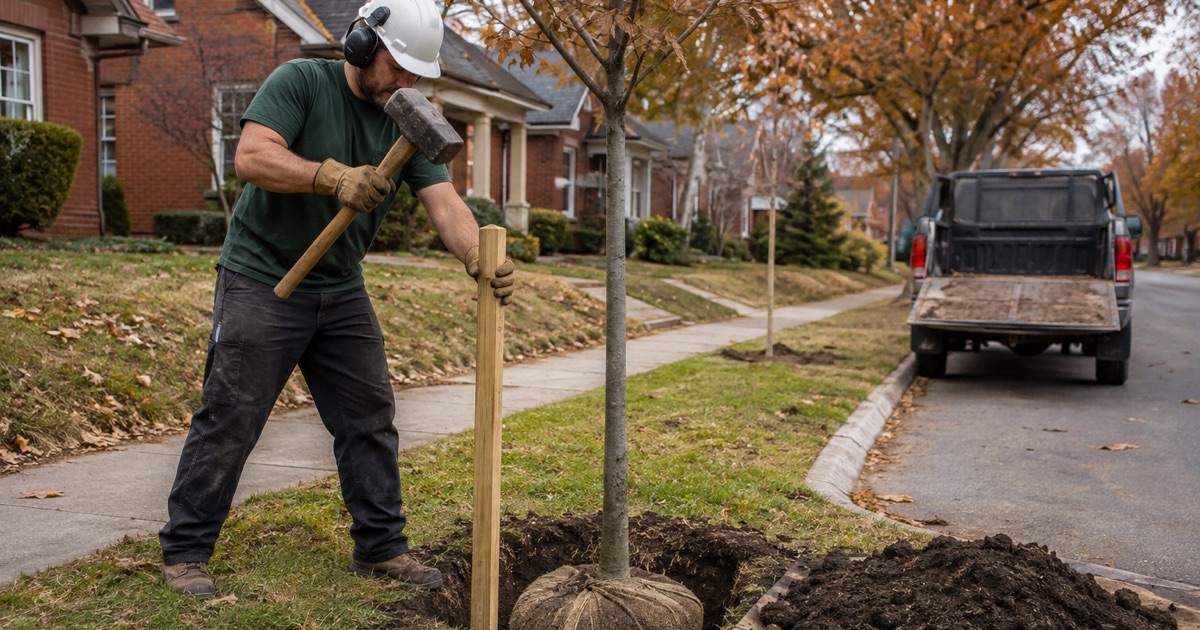
Most trees planted correctly do not need staking at all, and the movement they get in wind is what builds trunk taper and anchoring roots. Where wind exposure or a loose ball forces it, ties go on wide and flexible, low enough to allow sway, with a date to come off. Hardware left on a growing trunk becomes the defect it was installed to prevent.
Structural Pruning While It Is Still Cheap
The defects that eventually take a tree down — co-dominant stems, included bark, a low fork over a driveway — are visible and correctable in the first ten years with hand pruners. The same corrections at forty years cost a crane. Structural pruning on a young tree is the least expensive tree work anyone in this trade sells, and almost nobody asks for it.
- 20+ Years in the Valley
- Free Written Estimates
- Same-Day Storm Calls